Boiler Efficiency Technology: The Systems That Cut Fuel Costs and Improve Performance
Why Modern Boiler Efficiency Matters More Than Ever
In any facility with a boiler room, fuel is one of the largest and most volatile operating expenses. As energy costs continue to rise and emissions regulations become stricter, boiler efficiency is no longer a “nice-to-have” feature—it’s a critical component of a financially sound operation. Investing in modern efficiency technology is not just about environmental responsibility; it’s a direct path to reducing operational costs and improving your bottom line.
A boiler’s nameplate efficiency rating is only the beginning of the story. True performance is determined by how well the system operates under real-world load conditions. Modern efficiency systems—from advanced burners and controls to heat recovery equipment—are engineered to optimize performance across the entire firing range. The return on investment for these upgrades is often surprisingly fast, paying for itself through tangible fuel savings.
High-Efficiency Burners: Better Combustion, Lower Fuel Bills
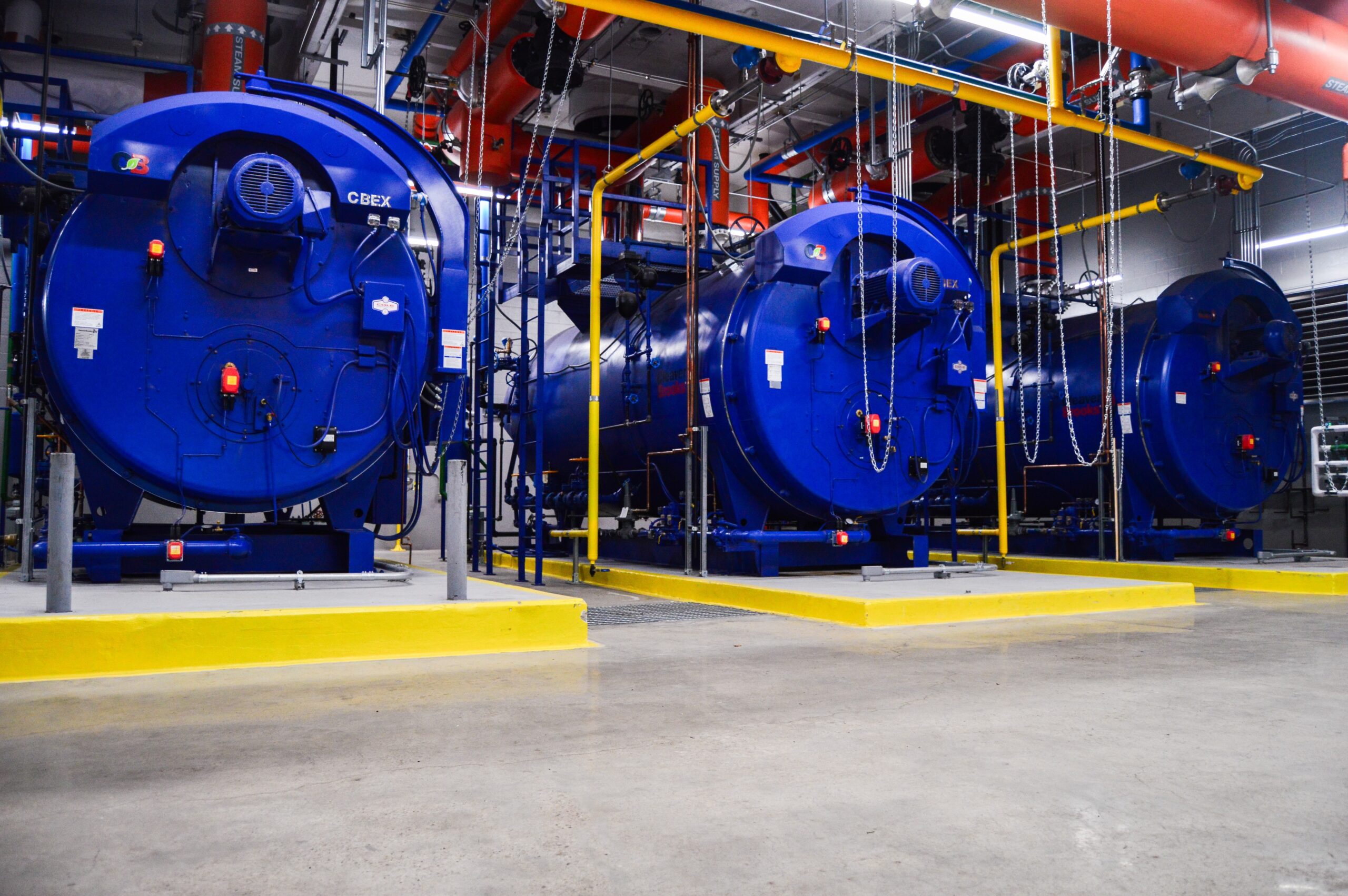
The burner is the engine of your boiler. It is where fuel and air are mixed and ignited to produce heat. An old, inefficient burner can waste a significant amount of fuel, whereas a modern, high-efficiency burner is designed for precision and control, directly translating to lower energy consumption. The two most accepted burner designs in the industrial and commercial market place are the internal industrial register burner and the external jet type burner. Both of these can be installed on industrial watertube and firetube boilers. The internal industrial register burner utilizes a windbox and has the least amount of air slop for precise fuel-to-air ratios. Please contact Cole Industrial for more information on either design.
How Modern Burners Improve Turndown and Control
Turndown ratio refers to a burner’s ability to operate at lower firing rates. An old burner with a 3:1 turndown ratio on a 500 HP boiler can only run as low as 167 HP before it shuts off, leading to wasteful cycling. A modern burner can achieve turndown ratios of 10:1 or higher, allowing it to run as low as 50 HP. This ability to modulate down to match low loads prevents constant starting and stopping, which saves fuel and reduces wear on components.
Fuel Savings From Precise Combustion
High-efficiency burners use advanced fuel-to-air control systems to maintain a proper combustion mixture. This allows for reduced excess air. Some excess air is required, however by reducing excess air, a modern burner ensures that more of the fuel’s energy is transferred to the water, not wasted as hot exhaust gas.
Low-NOx Options for Regulatory Compliance
In many regions, including the Pacific Northwest, air quality standards for Nitrogen Oxides (NOx) are becoming increasingly stringent. Modern low-NOx burners use technologies like flue gas recirculation (FGR) and precisely staged combustion to reduce NOx formation to single-digit parts per million (ppm) levels, ensuring your facility remains compliant without sacrificing performance. Check to see which manufacturers guarantee the burner emission levels. Cleaver-Broks stands by the guaranteed / published emission levels for their burner designs.
When a Burner Upgrade Makes a Bigger Difference Than a Boiler Replacement
If your boiler’s pressure vessel is still in good condition, a burner retrofit is often the single most cost-effective upgrade you can make. It can deliver 80% of the efficiency gains of a full boiler replacement for a fraction of the cost and with significantly less downtime.
Condensing Boiler Technology: Capturing Heat That Used to Be Wasted
Condensing technology represents a major leap forward in boiler efficiency, for hydronic (hot water) heating systems. These boilers are designed to extract not only the sensible heat from combustion but also the latent heat that is normally lost in the water vapor of the exhaust gas.
How Condensing Works and Where It Makes Sense
When a fuel like natural gas burns, it produces water vapor. In a conventional boiler, this vapor goes up the stack, carrying its heat with it. A condensing boiler operates at lower hot water temperatures driving the efficiency up and the stack temperatures down. The dew point of natural gas is around 127°F. This forces the water vapor to condense back into liquid water, releasing its latent heat, which is then transferred into the boiler water. This means less Btu’s from the fuel are used to heat the hot water to the HW set point.
Required Return Water Temperatures for True Efficiency Gains
This process only works if the water returning to the boiler is cool enough to condense the flue gas. For a condensing boiler to achieve its peak efficiency of 95% or higher, the return water temperature must be below 135°F. The cooler the return water, the more condensation occurs and the higher the efficiency.
Applications Best Suited for Condensing Boilers
Condensing boilers are ideal for low-temperature applications like radiant floor heating, snow melting systems, and domestic hot water pre-heating. They are also a great fit for any facility with a highly variable load, often deployed in modular arrays where multiple smaller units work together to precisely match demand.
Expected Fuel Savings Under Real-World Conditions
In the right application, a condensing boiler can be 10-15% more efficient than a conventional non-condensing boiler. This translates directly into a 10-15% reduction in fuel consumption, offering a rapid payback on the initial investment.
Oxygen Trim and Modulating Controls: Smarter Operation for Any Boiler Type
Even the best burner needs a smart control system to perform at its peak. Modern boiler controls use real-time data to make constant micro-adjustments, ensuring the boiler operates at maximum efficiency regardless of changing conditions.
Heat Recovery Systems: Economizers, Stack Heat Recovery, and More
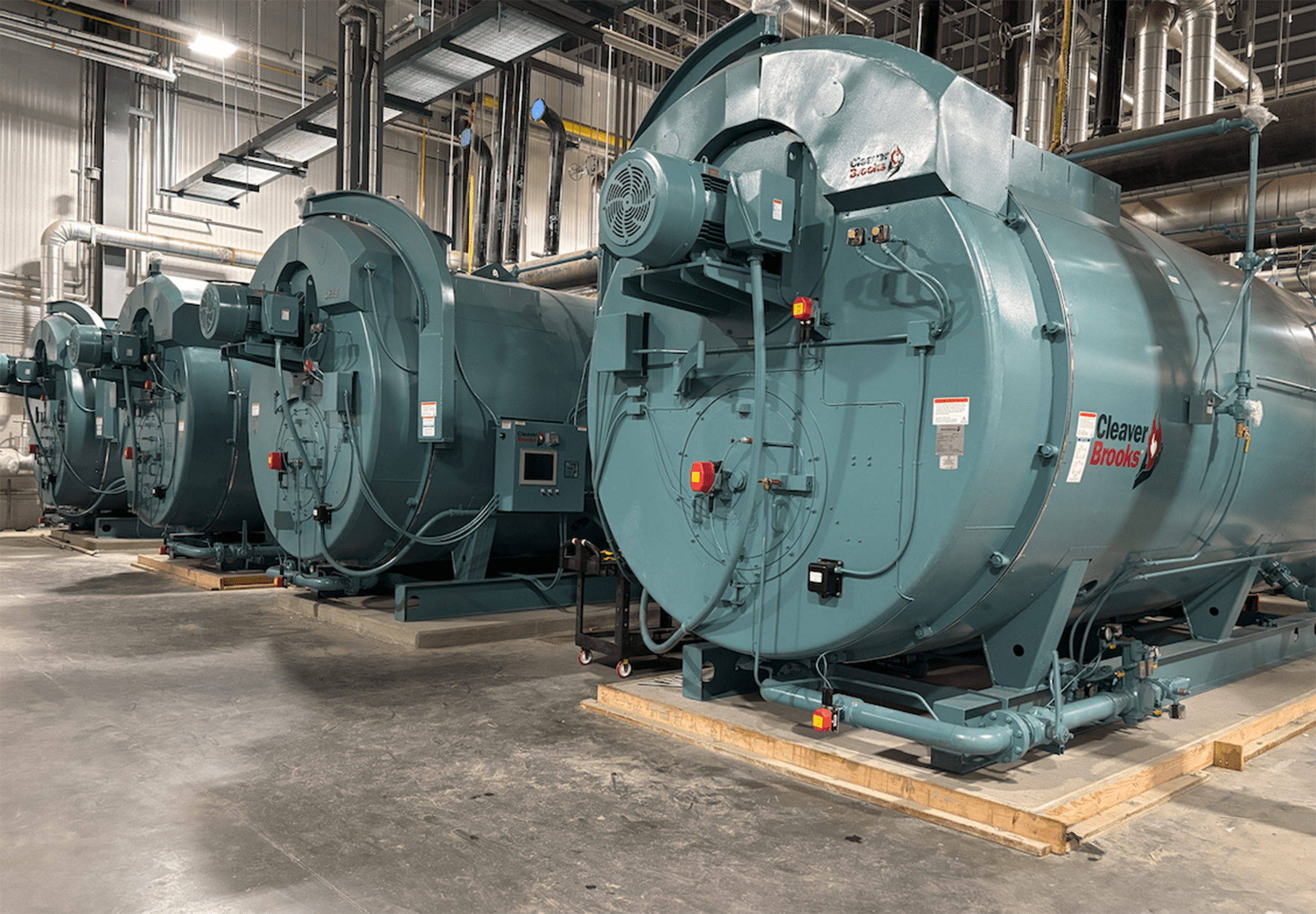
A significant amount of a boiler’s energy is lost as hot exhaust gas leaving the stack. Heat recovery systems are designed to capture this waste heat and put it back to work, dramatically increasing the boiler’s overall thermal efficiency.
How Economizers Reduce Fuel Consumption
A stack economizer is a heat exchanger installed in the boiler’s exhaust flue. It uses the hot flue gases (typically 300-500°F) to preheat the colder feedwater before it enters the boiler. Because the water is already partially heated, the boiler’s burner doesn’t have to work as hard, directly reducing fuel consumption. A properly sized economizer can boost boiler efficiency by 4-8%.
Types of Heat Recovery for Steam vs Hot Water Boilers
For steam boilers, a feedwater economizer is the most common type. For hydronic (hot water) systems, a condensing economizer can be used to capture both sensible and latent heat, providing even greater efficiency gains, provided the system temperatures are compatible.
Installation Requirements and ROI Considerations
Retrofitting an economizer requires space in the stack and modifications to the feedwater piping. However, the fuel savings are significant and predictable. For any process steam boiler running a significant number of hours per year, an economizer is one of the most reliable efficiency investments you can make.
Industry Applications Where Heat Recovery Has the Highest Impact
Facilities with high makeup water requirements, such as food processing plants, laundries, and chemical plants, see the largest benefit from heat recovery. Any operation that runs continuously and uses a large volume of steam or hot water is a prime candidate for an economizer.
How Efficiency Technology Reduces Fuel Usage and Operating Costs
The primary benefit of efficiency technology is a direct reduction in your monthly fuel bill. By making the boiler work smarter, not harder, these systems deliver measurable savings.
Comparing Fuel Savings Across Different Upgrades
A burner upgrade might save 5-10% on fuel. An economizer can add another 4-8%. An O2 trim system can contribute 1-3%. When stacked together, these technologies can improve the efficiency of an older boiler by 15% or more, transforming its operating cost profile.
Emissions Reductions and Compliance Benefits
More efficient combustion means fewer emissions. Upgrading to a modern low-NOx burner not only saves fuel but also ensures your facility meets tightening air quality standards, avoiding potential fines and operational restrictions.
Impact on Maintenance and Boiler Life
A well-tuned, efficient boiler experiences less stress. By eliminating rapid cycling and maintaining stable combustion, modern controls and burners reduce wear and tear on boiler tubes, refractory, and other critical components, extending the reliable service life of the entire system.

How to Choose the Right Efficiency Technology for Your Boiler Room
The right choice depends on your specific equipment, operating conditions, and financial goals. Cole Industrial has certified Boiler Plant Optimization Specialists available to assist in determining ideal equipment and operating strategies for your specific application.
Manufacturers Offering High-Efficiency Boiler Technology
We partner with industry leaders who engineer and build the most reliable and efficient boiler room equipment available. Cleaver-Brooks offers full “single source” boiler system designs.
Understanding the ROI Behind Efficiency Upgrades
We provide a clear financial analysis to justify every efficiency project.
Fuel Savings vs Upgrade Costs
We calculate your current annual fuel cost and compare it against the projected cost after an upgrade. This shows you the hard-dollar savings you can expect to see each year.
Payback Periods for Burners, Controls, and Heat Recovery
We divide the total project cost by the annual fuel savings to determine the simple payback period. Many efficiency projects pay for themselves in just 1-3 years, delivering free savings for the remainder of the equipment’s life.
Frequently Asked Questions About Boiler Efficiency Technology
Absolutely. As long as the pressure vessel is in good condition, retrofitting a modern burner, controls, or an economizer is often the most financially sound way to reduce operating costs and extend the boiler’s life.
Not directly. However, a condensing stack economizer can be added to a non-condensing boiler to capture some latent heat, providing a portion of the benefits of a full condensing system.
The fastest way is often to perform a professional burner tune-up. A poorly tuned burner can waste 5-10% of your fuel. After that, a burner or control system upgrade typically offers the quickest payback.
Yes, most upgrades require a planned shutdown. However, a burner or control retrofit can often be completed in a few days, while an economizer installation might take a week. We work with your team to schedule the work during planned outages to minimize disruption.
Want to Improve Boiler Efficiency? We’ll Help You Choose the Right Technology
You don’t need to be an energy expert to cut your facility’s fuel costs. The team at Cole Industrial has been designing and implementing high-efficiency boiler systems for over 60 years. We have the technical expertise to identify the upgrades that will deliver the greatest return for your specific operation.
Contact Cole Industrial today for a professional evaluation of your boiler system and a clear roadmap to higher efficiency and lower operating costs. A BPO specialist can provide you and your team a Boiler Plant Optimization Overview Report.